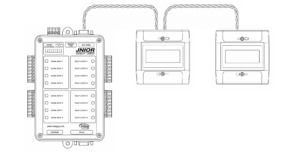
RS-485 vs. EKM Power Meter
Summary: A practical look at using RS-485 to network multiple EKM power meters with a JNIOR. We follow the application from the two-wire connection through Java communications and protocol handling to retrieving real-time power and cumulative energy measurements.
An electronic power meter can be easily added to an electrical panel to measure the power being used by a home, a piece of equipment or an individual circuit. In addition to accumulating energy usage in kilowatt-hours, these meters can provide voltage, current, instantaneous power, power factor, frequency and other useful measurements.
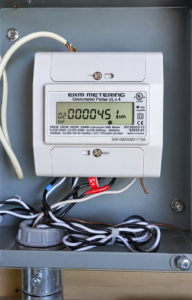
To measure power, the meter needs to know both voltage and current. Voltage is measured by connecting the meter to each electrical leg being monitored. Current is measured using a current transformer, or CT, that snaps around the conductor, often immediately after the circuit breaker. The load current does not need to pass through the meter itself. This makes adding a meter to an existing installation relatively straightforward.
This can be particularly useful in a solar installation. Solar inverters generally provide information about how much power they are generating. The electric utility’s meter, on the other hand, measures the net power flowing between the property and the grid. If the home is consuming 5 kW while the solar system is producing 3 kW, the utility meter sees only the remaining 2 kW being supplied by the grid. Neither measurement by itself tells you the whole story.
The utility meter may contain much of the information that you would like to have, but generally you cannot simply connect to it and retrieve those measurements programmatically. You can read its display and the utility can collect information from it remotely, but access to its electronic interface is typically reserved for the utility.
Adding your own power meter gives you a measurement that you control. Combined with the production data available from the solar inverters, a meter measuring the home makes it possible to calculate where the power is coming from and where it is going. More importantly, those measurements can be retrieved by software. They can be logged, graphed, displayed remotely, used to generate alarms or incorporated into other calculations and control decisions.